
Repair guide
uPVC Door Handle Loose? Checks Before Replacing It
By the Newcastle Window and Door Repairs team
Last updated:
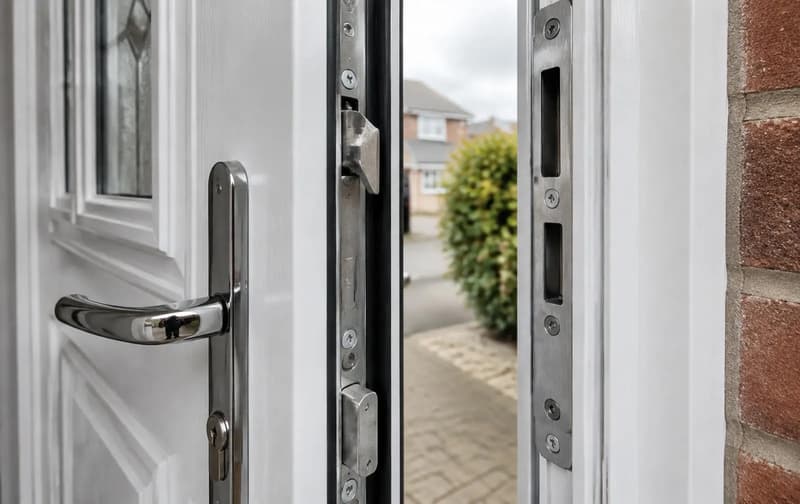
A loose uPVC door handle can mean several different things. The whole backplate may move against the door, the lever may droop below its usual position, or the handle may turn without operating the lock. Those observations point to different parts, so replacing the visible handle is not always the answer.
Start by noticing which part moves and whether the entrance still closes and locks normally. Avoid pulling harder to compensate for the looseness. This guide is about that movement and loss of support; the separate handle replacement guide explains choosing a suitable new handle when replacement is necessary.
Repair first
15 minute replies
Working hours
Free in-person quotes
Fully insured
Guaranteed workmanship
Need it sorted? Book a door handle repair
Describe the movement so the handle and its mechanism can be assessed together.
When the backplate moves against the door
If the lever and its plate move together, the fixing arrangement may be loose rather than the spring being weak. Look at the plate while moving the handle gently. A visible gap appearing between plate and door is a different symptom from a lever that drops while its plate stays firmly in place.
With the door secure and safely supported, check only accessible visible screws for obvious looseness. Do not remove the plates, over-tighten fixings or keep turning a screw that will not grip. Excess pressure can distort the fitting, and a damaged fixing needs more than repeated tightening. Photograph the movement or describe it when asking for advice.
A drooping lever and its spring support
Some handle arrangements use spring cassettes to return the lever to its resting position. Worn spring support can leave it sagging even though the backplate is tight. The return action also depends on the particular handle and mechanism arrangement, so not every drooping lever has a separate cassette that can simply be swapped.
Notice whether the handle returns after a gentle movement and whether both sides behave similarly. Do not add a stronger spring or an improvised packing piece to force it upright. The spindle and the parts it connects to need to remain compatible. A repair assessment establishes whether the spring support, the handle assembly or another component is responsible.
Free movement can involve the gearbox
A handle that moves unusually freely and no longer shifts the locking points may have lost its connection to the mechanism. A worn spindle or failed gearbox can produce that empty feeling. A new lever alone will not restore a gearbox that no longer operates the multipoint lock.
If the entrance is becoming difficult to secure, stop treating the problem as cosmetic. Explain whether lifting the lever moves anything along the door edge and whether the key still works. Only observe that action if the door opens safely; do not dismantle the edge mechanism to investigate a fault you cannot identify from outside.
uPVC door repairs
- Doors that need lifting or shouldering to lock
- Handles that spin, sag or feel spongy
- Snapped or seized multipoint lock mechanisms
Is the door also catching?
Looseness can be noticed at the same time as a door becomes hard to close, but the two faults should not be confused. A dropped door puts strain on the handle when the locking points do not meet their keeps. Tightening the plate cannot correct the alignment between the leaf and frame.
Note whether the locking action changes with the door open compared with closed, without forcing either test. That detail helps distinguish operating hardware from alignment. Our uPVC door repairs service considers those related faults together, so an apparently small handle problem does not lead to an unsuitable part being fitted.
Deciding between repair and replacement
A loose fixing, worn spring arrangement and damaged handle do not all require the same work. Read uPVC door handle replacement for the fix-or-replace decision and the measurements involved. If the plate is sound but the mechanism is failing, replacement of the plate is not the relevant repair.
For a free in-person quotation, give the symptoms rather than a guessed part name: plate movement, lever droop, empty turning or difficulty locking. Use the quote form below and add photographs if available. A door that will not secure needs a call about repair help, rather than being left with a handle repeatedly pulled back into position.
Repairs for loose upvc door handle
Local help with loose upvc door handle
Want a professional to handle it?
Questions
Frequently asked
Why does my door handle sag even though the plate is tight?
The lever's return support may be worn, including a spring cassette where that arrangement is fitted. The particular handle and mechanism must be checked before deciding which part needs attention.
Should I keep tightening a door handle screw that will not grip?
No. Repeated turning is not a remedy for a damaged fixing. Leave dismantling and the suitability of the fixing arrangement to the repair assessment.
Can a loose handle still indicate a gearbox problem?
Yes, particularly if it turns with very little resistance and does not operate the locking points. That is different from a backplate moving against the door.
Ask about loose upvc door handle
Photo estimates sometimes possible.
Related services
Covering Newcastle and the North East.