
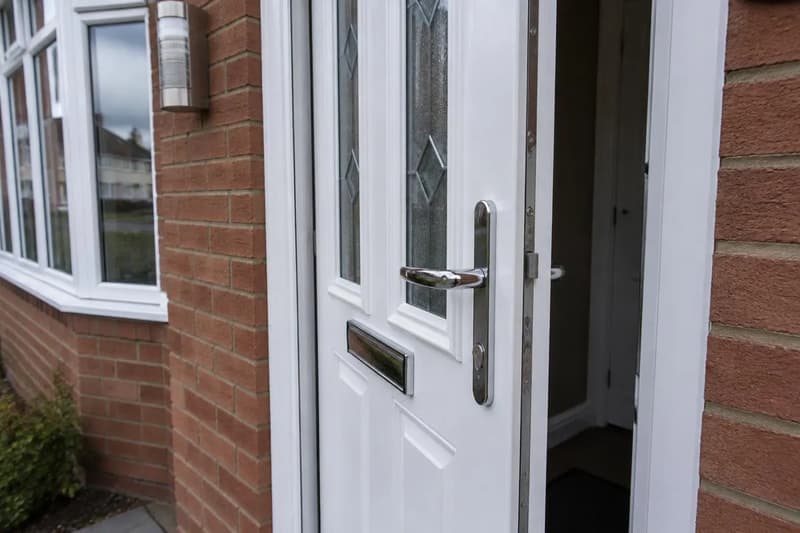
Repair service
Composite Door Repairs in Newcastle: Dropped Doors and Worn Hardware
Composite doors are heavier than uPVC doors, with a solid core slab hung in a uPVC or timber frame. That extra weight is what makes them feel solid, and it is also why their hinges and locking gear work so hard.
When a composite door drops, catches the frame or will not lock without a shove, the slab itself is rarely the problem. We deal with the hinges, keeps and mechanism that hold it in place.
Guaranteed workmanship.
Repair first
15 minute replies
Working hours
Free in-person quotes
Fully insured
Guaranteed workmanship
Composite door problems we fix
- The door catches the frame or scrapes the threshold
- You have to lift the handle hard to lock it
- The key is stiff or will not turn
- The handle is loose, drooping or spins
- Daylight or draughts round the edge of the slab
- Swelling or sticking after hot or wet weather
Hinge adjustment for a heavy slab
For a side by side look at composite, uPVC, timber and aluminium doors, start with our door repairs page.
Most composite doors use adjustable flag hinges. As the door settles, it drops towards the lock side and starts to catch. We adjust the hinges for height, lateral position and compression so the slab sits square and closes onto its seals evenly.
Where hinges have worn or cracked under the weight, we replace them with suitable heavy duty hinges.
Multipoint locks and gearboxes
Composite doors lock with a multipoint mechanism: a central gearbox, hooks or rollers along the edge and keeps in the frame. If the door has dropped, those points fight the keeps and the gearbox takes the strain until it fails.
We realign first, then replace the gearbox or the full mechanism only if it has actually worn. We also fit replacement handles and anti snap cylinders.
How this differs from a uPVC door
Composite and uPVC doors share some locking hardware, but the slab weight and thickness mean different hinges, longer cylinders and more careful adjustment. Our separate uPVC door repairs page covers lighter hollow uPVC doors.
The slab, the hinges and the lock are different decisions
A solid composite slab can still be serviceable when the parts supporting it need work. Catching at the frame, scraping at the threshold or having to shove the door shut does not automatically mean the slab must go. The hinge position and the way the locking points meet their keeps are central to the repair assessment. That is why we start with alignment rather than assuming a difficult front door needs a new lock or a new door.
Adjustment changes how the slab sits: height, lateral position and compression are considered so the door closes evenly against its seals. Worn or cracked hinges are a different matter and may need replacement with suitable heavy duty hinges. Both approaches address the hardware carrying the weight. The choice between them comes from its condition, not simply from the fact that the door is heavy.
A hard-to-lift handle does not diagnose the gearbox
The handle operates a mechanism with a central gearbox and locking points along the edge of the door. When those points fight against the keeps, the handle becomes part of that struggle. A stiff lift is therefore useful information, but not enough on its own to decide that the gearbox has failed. Tell us whether the slab also catches, whether the key turns, and whether the handle is loose, drooping or spinning.
Realigning the door comes before replacing the gearbox or complete mechanism unless the part has actually worn. Replacement handles and anti snap cylinders are separate options within the existing service. A worn handle, a strained lock and a dropped slab can be related without being interchangeable faults. We aim to identify which parts need work and which can remain, rather than changing the entire locking assembly by default.
Weather-related sticking and gaps around the slab
If sticking is noticeable in hot weather, mention that in the enquiry. The existing composite door advice recognises that slight expansion can make a door catch when its adjustment is already tight. The condition of the hinges and keeps needs consideration alongside that symptom. Daylight or a draught around the edge is also worth describing, particularly if the gaps are uneven or the slab no longer closes cleanly onto its seals.
Composite doors share some hardware with uPVC doors, but their slab weight and thickness matter when choosing hinges, cylinders and adjustment. Advice for a lighter uPVC door should not be treated as a reason to order the same parts for a composite entrance. Our service is focused on the dropped slab, the supports and the locking system already described here. Repairing those parts is the starting point, not persuading you to replace an otherwise usable door.
Composite door repair beyond the lock
A composite door repair often starts with the lock, but the slab, glass and frame need looking at too. Lock faults are covered on uPVC door lock replacement, as composite doors use the same style of multipoint mechanism. Cracked or misted glazed sections are handled under door glass replacement.
Some composite style doors use a separate infill panel rather than a solid slab. Where that panel is damaged, uPVC door panel replacement can be the answer. We check which construction your door uses before suggesting a fix.
Weight and alignment
Composite doors are heavier than most uPVC doors, and that weight is carried by the hinges and their fixings. Over time it can pull the door down at the lock side, so the handle gets harder to lift. Resetting the door early protects the lock from strain.
Separate the lock fault from the composite leaf
A cylinder or multipoint fault has its own composite door lock replacement service. The locking components are assessed alongside the leaf's alignment, without assuming that a sound door needs replacing.
Related specialist repairs
Questions
Frequently asked
Why won't my composite door lock?
Usually the door has dropped so the locking points no longer line up with the keeps. Hinge adjustment often fixes it; if the gearbox has failed we replace it.
Can a dropped composite door be fixed without replacing it?
Yes. Adjusting or replacing the hinges lifts the slab back into line, and the door itself stays in place.
Why is my composite door sticking in summer?
Composite slabs can expand slightly in heat, so a door that is only just in adjustment starts to catch. Resetting the hinges and keeps gives it room to move.
Can you replace the lock on a composite door?
Yes. We replace multipoint mechanisms, gearboxes, cylinders and handles on composite doors.
Is my composite door secure if the key is stiff?
A stiff key is an early warning that the mechanism is under strain. Getting the door realigned before the gearbox fails keeps it secure.
Can the glass in a composite door be replaced on its own?
In most cases, yes. The glazed section is held in a cassette or by beads and can be replaced while the door stays in place.
Why has my composite door become hard to lock?
The weight of the slab can make the door drop slightly, so the locking points no longer meet the keeps. Realigning it usually solves the problem.
Can a damaged composite door skin be repaired?
It depends on the damage and the door construction. We look at it in person and explain the options before quoting.
Read more
Guides that go with this repair
Discuss composite door repairs
Photo estimates sometimes possible.